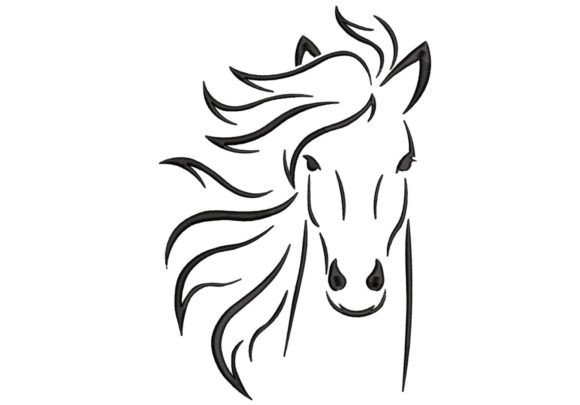
Line Art Horse
First Impressions: Clean, Confident, and Quietly Powerful
When I opened Line Art Horse for the first time, I didn’t see a “cute” or “trendy” horse — I saw restraint. A single, unbroken contour tracing the curve of a neck, the arch of a back, the subtle flare of a nostril. No fill stitches, no satin borders, no decorative flourishes. Just line — deliberate, fluid, and deeply respectful of negative space. It’s not shouting. It’s breathing. That’s rare in machine embroidery design, where many default to density over intention. This one feels like it belongs on a linen tea towel for a boutique kitchen shop, not a glitter-embellished onesie.
A Real Test: Stitching It on a Natural-Canvas Tote Bag
Last week, I prepped Line Art Horse for a custom order: an organic cotton tote for a local equestrian therapist. She wanted something serene, not sporty — no jumping silhouettes or ribboned manes. Just presence. I hooped medium-weight cutaway stabilizer, used 40-weight polyester thread in charcoal grey, and stitched at 8.5" wide (centered on the bag’s side panel). The result? Crisp, even lines with zero skipped stitches — even through the slight texture of the fabric. No puckering. No thread breaks. The horse read clearly from six feet away, yet softened beautifully up close. Customers paused mid-shop to trace the shape with their fingers. That’s the quiet power of well-digitized line art: it invites engagement without demanding attention.
Where Line Art Horse Truly Shines
- Custom apparel: Works exceptionally well on sweatshirts and relaxed-fit tees — the line weight holds structure without stiffness, and the minimalism reads as intentional, not sparse.
- Baby and nursery items: Perfect for muslin swaddles, linen crib sheets, or cotton-knit blankets. Its gentle profile avoids visual overload in calming spaces.
- Embroidered patches: Digitized cleanly enough to stitch cleanly at 3–4" wide, then heat-seal or sew-on without fraying edges or lost definition.
- Holiday and wedding gifts: Paired with a simple monogram or date on a linen pillow cover or ceramic mug wrap, it adds heirloom-level quiet sophistication.
- Etsy listings and craft fair merch: Photographs beautifully in natural light. Converts well because it feels handmade *and* professionally designed — no “clipart” energy.
Where to Proceed Thoughtfully
Line Art Horse isn’t magic — it’s a tool. And like any precise tool, it has ideal conditions. Use caution on:
- Stretchy fabrics (like ribbed knits or lightweight jersey) — the line relies on stability; without proper stabilizer and tension control, curves can distort.
- Dark or heavily textured fabrics — fine line work can visually recede or blur if thread contrast is low or fabric nap interrupts continuity.
- Curved surfaces (caps, curved apron pockets) — test placement carefully; long, uninterrupted lines can stretch or compress near seams or crowns.
- Sub-3" scaling — while elegant at scale, shrinking too far risks losing the confident rhythm of the line. Below 2.5", small curves may digitize into jagged approximations.
- Frequent-wash items (like baby bibs or kitchen towels) — confirm stitch density supports durability; running stitch alone won’t hold up like a satin or fill — but that’s by design, not flaw.
What It Adds to Your Finished Product — Beyond Aesthetics
This isn’t just about how Line Art Horse looks — it’s about how your customer *feels* holding it. On a hand-stitched-look pillow cover, it signals care and curation. On a boutique sweatshirt, it elevates brand perception from “crafty” to “considered.” For Etsy sellers, it strengthens buyer trust: clean line art implies technical competence and design maturity. For small shop owners, it layers meaning without clutter — customers recognize the horse motif instantly, but the execution feels fresh, not recycled. It also photographs cleanly across digital mockups, saving time on listing visuals. And crucially? It leaves room for *your* voice — whether you pair it with hand-lettered text, botanical accents, or minimalist packaging.
Practical Designer Notes Before You Stitch
- Always run a test on scrap fabric matching your project’s weight and stretch — especially for custom apparel or baby items.
- Check thread color contrast on both light and dark backgrounds; this design lives or dies by legibility.
- Review stitch density — though minimal, ensure no areas are overly sparse for your fabric type.
- Confirm hoop size compatibility before finalizing layout; its graceful proportions benefit from generous breathing room.
- Inspect corners and tight curves in your embroidery software — look for smooth vector transitions, not pixelated jumps.
- Test black-and-white mockups — if it reads strongly without color, you’ve got a winner for versatile branding.
- Use appropriate stabilizer: cutaway for knits, tear-away for stable wovens, and consider topping for napped fabrics.
- Verify licensing terms before selling finished products or bundling Line Art Horse as part of a digital embroidery file pack.
Final Thought: Less Is Anchored, Not Empty
Many designers chase complexity — more stitches, more layers, more “wow.” But Line Art Horse reminds me why I started embroidering in the first place: to distill feeling into form. It doesn’t need embellishment. It doesn’t beg for attention. It simply holds space — gracefully, confidently, and with unmistakable craft. Whether you’re stitching a single gift or building a collection of design assets for your craft business, this is the kind of embroidery file that grows more valuable the longer you work with it. It’s not background noise. It’s quiet authority — stitched, one deliberate line at a time.