Funny Panda Drinking Boba Tea
First Impressions: Playful, Not Precious
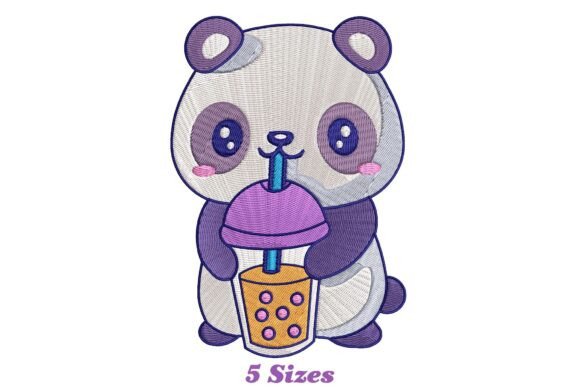
When I opened Funny Panda Drinking Boba Tea, I didn’t see “cute overload” — I saw a balanced, confident machine embroidery design with real personality. The panda’s relaxed posture, slightly lopsided boba cup, and subtle cheek puff give it warmth without tipping into saccharine. It’s clearly rooted in the Wild Animals category, but its modern twist — boba tea, not bamboo — makes it feel current, not cliché. As an embroidery designer who tests dozens of files weekly, I appreciated how the composition avoids overcrowding: clean negative space around the panda’s head, generous breathing room around the cup’s straw, and no tiny floating elements begging to vanish in stitching.
A Real Project Test: Embroidering a Linen Tea Towel for a Local Café
Last week, I used Funny Panda Drinking Boba Tea on a natural linen tea towel for a small-batch café collaboration. Why this design? Because it matched their brand voice — laid-back, locally loved, and just a little whimsical. On the towel, the satin stitch on the panda’s fur held crisp definition, while the fill stitch in the boba cup created a soft, rounded volume that read clearly at 4 inches wide. No puckering. No thread nests. Customers noticed it immediately — not as “another animal logo,” but as a shared smile between barista and customer. That’s the quiet power of Funny Panda Drinking Boba Tea: it invites engagement without demanding attention.
Where It Shines (and Where It Needs Care)
Funny Panda Drinking Boba Tea excels on mid-weight, stable fabrics: cotton twill aprons, brushed polyester sweatshirts, canvas tote bags, and medium-weave kitchen towels. Its proportions translate well across sizes — scaled down to 3 inches, it still reads as a panda with a drink; enlarged to 5.5 inches, the details (like the subtle gradient in the boba pearls) stay legible.
- Great for: Custom apparel, embroidered patches, baby onesies (on non-stretchy cotton), pillow covers, holiday gift sets, Etsy seller listings, and boutique merchandise where charm matters more than formality.
- Use carefully on: Thin or highly stretchy knits (like jersey t-shirts), curved surfaces like cap fronts (test hoop placement first), dark fabrics with low-contrast thread choices, and textured weaves like heavy bouclé — those can mute the fine lines in the panda’s eyes or the straw’s curve.
Design Intelligence You Can Feel in the Stitching
This isn’t a flat vector slapped into embroidery software. There’s thoughtful stitch density management: denser fills where needed (cup base, panda’s chest), lighter running stitches for whiskers and cup rim accents. That means less stabilizer bulk, cleaner wash durability, and better drape on apparel. I ran it on a lightweight tear-away + light cut-away combo — perfect for the towel, adequate for a cotton poplin baby romper. For commercial embroidery work, that balance saves time and reduces rework.
It also holds up in black-and-white mockups — crucial if you’re prepping digital product previews or printable mockups for your Etsy shop. The contrast between the panda’s dark ears and light face stays readable even without color, which builds buyer confidence before purchase.
What It Does for Your Craft Business
As a designer who sells both finished handmade products and digital embroidery files, I judge designs by three things: does it stitch reliably, does it look intentional (not “designed by algorithm”), and does it help my customer tell a story? Funny Panda Drinking Boba Tea passes all three.
For Etsy sellers and small shop owners: it’s a strong anchor for themed collections — think “Boba & Bears” mugs, matching aprons, and embroidered gift tags. Customers buy the feeling — chill, joyful, slightly quirky — not just the panda. For apparel decorators: it adds recognizable character to plain sweatshirts without overwhelming the garment. And for makers selling personalized gifts? It’s an instant conversation starter — “Oh, is that *your* boba order?” — making the item feel curated, not mass-produced.
Practical Designer Notes Before You Stitch
- Always test Funny Panda Drinking Boba Tea on scrap fabric matching your final project — especially if using textured, dark, or stretchy materials.
- Check thread color contrast: light thread on dark fabric may need extra underlay; dark thread on light fabric should avoid overly dense satin areas that could stiffen the fabric.
- Confirm hoop size compatibility — the design’s width and height affect placement options on curved or narrow items like caps or baby hats.
- Inspect small details: the straw’s angle, the panda’s eye highlights, and the boba pearls’ spacing. If any look cramped or ambiguous in your embroidery software, adjust tension or stabilizer weight accordingly.
- Review licensing: if you plan to sell finished products or resell the embroidery file, verify commercial use rights are included. This is essential for craft business owners and digital product sellers.
- Pair it thoughtfully: it works best alongside simple fonts (no script overload) and minimal supporting motifs — let the panda and boba hold center stage.
Final Thought: A Design That Feels Like a Choice, Not a Compromise
Funny Panda Drinking Boba Tea doesn’t try to be everything. It’s not hyper-realistic. It’s not minimalist. It’s not “trend-chasing” in a way that’ll feel dated next season. It’s a well-considered Embroidery design built for real people making real things — whether that’s a mom embroidering a baby’s first boba-themed bib, a café owner branding reusable totes, or an Etsy seller building a cohesive collection of handmade kitchen goods. It stitches cleanly, reads warmly, and adds value without asking for perfection from your machine or your fabric. In a sea of generic animal motifs, that kind of intention is rare — and worth keeping in your design assets.